Introduction
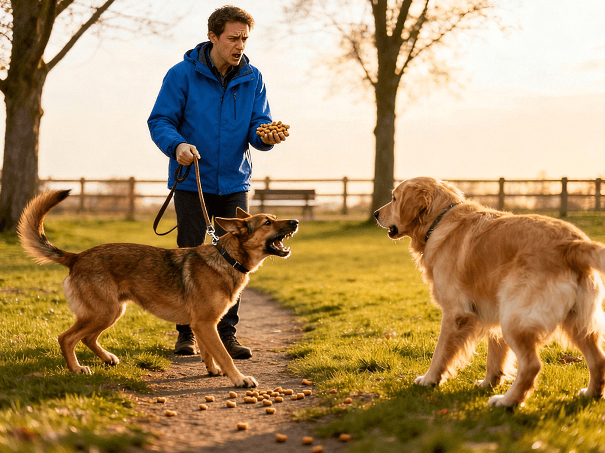
For many owners of reactive dogs, it can feel as if you have tried every food-based strategy under the sun, from chicken and cheese to gourmet training treats, only to find that nothing really shifts your dog’s behaviour. You stand at the park with a pocket full of snacks, your dog spots another dog, and, in that split second, it is as if you and your treats disappear. It is frustrating, disheartening and can leave you wondering if you are doing something wrong or if your dog is simply “untrainable”. This is where looking beyond food and tapping into the power of play, especially tug, can offer a fresh, hopeful way forward for both you and your dog.
Concept
At the point the dog owner, recognises the signs of antecedence, they use the tug toy to change the dogs focus away from the other dog/person and maintains the dog within the ‘fun zone’. Additionally, this can be used at the early behaviour stages.
The idea is that instead of the ‘Red Mist’ descending onto the dog, they will associate the presence of other dogs as being fun time. Overtime, the reactive dogs will acknowledge the other dogs and then turn their attention towards their owners.
Using a tug toy as your “high value reward” can be more effective than food when working with reactive dogs, particularly when you want to keep them thinking, moving and having fun instead of tipping into that “red mist” state. Food is still useful, but tug gives you speed, engagement and emotional change in a way that snacks simply cannot match.
Switching from the red mist to the play mode
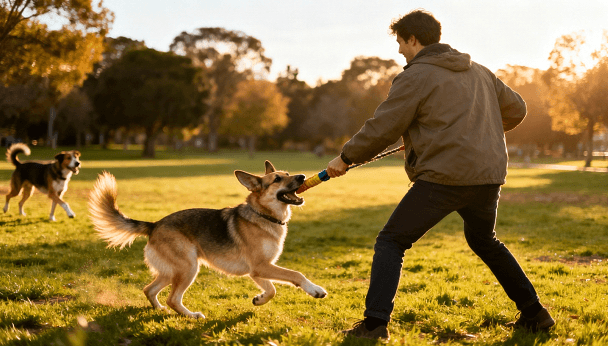
When a reactive dog spots a trigger, there is a brief window before the “red mist” fully descends, where their brain is still just about able to choose something different. The core idea of this approach is to use tug as a powerful, well‑rehearsed alternative in that window, so the dog learns to flip from “lock on and explode” into “grab the toy and play with my person.”
Instead of simply trying to block or suppress reactions with food, you deliberately create a new pattern: see the other dog, feel the feelings, then dive into a fast, physical, rules‑based game that keeps them in the fun zone and gradually rewires what those triggers mean.
Why tug beats treats for reactivity
Food tends to calm, slow and focus a dog on a single point, which is great for teaching precision but not always ideal when a dog is already aroused or over threshold. Tug, on the other hand, channels energy into play, movement and connection with the handler, which makes it much easier to shift a dog from “threat mode” into “game on with my human” mode. When the environment is busy or stressful, a fast, interactive game often has more pulling power than a static piece of food
The power of the “fun zone”
Think of the “fun zone” as the emotional space where your dog is excited, but still able to think and respond. When you spot the early antecedents of reactivity, such as a fixed stare, a weight shift forward or a small tension through the lead, you can immediately cue a tug game to hold your dog in that fun zone before the behaviour escalates. Instead of practising lunging and barking, the dog practises grabbing the toy, playing with you and staying engaged.
Used this way, the other dog or person becomes the trigger for the game, not for an outburst. Over time, your dog learns that seeing another dog predicts a brilliant round of tug with you, which changes their emotional response from “I need to get that thing away” to “Brilliant, it is playtime with my person.”
Using tug strategically at the earliest stages
The key is to step in at the first hint of the chain starting, not when your dog is already fully reacting. As soon as you notice those first small signs that your dog has noticed the other dog, you bring out the tug toy, move away to a workable distance if needed, and invite your dog into a game. The toy should be special, only brought out for training or tricky situations, so it retains very high value.
At this stage you are not “distracting” in a sloppy way, you are deliberately rehearsing an alternative behaviour pattern. Your dog notices the trigger, makes a choice to turn to you and then explodes into a controlled, rule-based tug game instead of exploding at the environment.
Building the new association
Over many repetitions, your dog starts to predict the pattern: other dog appears, mild awareness, turn to handler, fun starts. The presence of another dog now predicts a reward, rather than a threat or frustration, which shifts the whole emotional picture. Instead of red mist, you get recognition, a check-in with you and then a learned, practised response.
As this pattern beds in, you will often see the reactive dog glance at the trigger, then automatically flick their head back to you, effectively asking, “Are we playing now?” At that point you can start to stretch the behaviour, asking for a brief bit of heelwork, a sit or eye contact before the tug starts, while still protecting that strong association between other dogs and fun time with their owner.
Why toys can be more effective than food
⦁ Tug keeps the dog’s head up and eyes on you, rather than on the floor scanning for food, which supports better engagement and safer handling around triggers.
⦁ Play burns off excess arousal through movement and biting the toy, which can reduce the build-up of frustration that often tips into reactivity.
⦁ A tug toy is quick to deliver and quick to remove, so you can give very clear start and stop points to the game, making it easier to build impulse control around intense emotions.
How to use tug as a “red mist emergency exit”
When a reactive dog starts to slide into that red mist state, a well‑trained tug game can act like an emergency exit, giving them something intense, physical and positive to pour all that big feeling into while helping their thinking brain switch back on. Instead of waiting until they are fully exploding, you watch for those early signs that they are tipping over – the hard stare, a shift of weight towards the trigger, a growl, or the first surge on the lead – and that is your cue to step a pace or two away, bring out the tug and make it come alive so it is instantly more interesting than the other dog or person. The moment your dog chooses to turn to you and grab the tug, you mark that choice, move with them and really let them win and play, so the emotional high becomes linked to you and the game rather than to reacting at the environment.
Over time, the dog learns a very simple pattern: feel overwhelmed, see a trigger, then snap into tug with the handler instead of exploding. Once that pattern is established, you can build in an “off switch” by teaching a clean “out” or “drop” and adding short moments of focus or position between bouts of tug, so the dog practises coming down from arousal rather than staying stuck in it. For some dogs, a playful tactile prompt helps: as they lock onto the trigger with that intense stare, you lightly flick or bounce the tug on their side or leg a couple of times, making it dance in their peripheral vision and saying, in effect, “Over here, something better,” which often prompts them to spin round and grab the toy. This should always feel like a friendly, cheeky nudge into a favourite game, never a smack or a startle, and it must only be used with dogs who already see tug as safe and fun.
Handled this way, the tug toy stays firmly within the Least Intrusive, Minimally Aversive (LIMA (a welfare‑focused decision framework)) principles, because it is being used as a low‑level, play‑based cue layered on top of management and positive reinforcement, not as a punishment. You start with distance, good setups and simple presentation of the toy first; the light tap with the tug is only added if needed, and you watch the dog carefully for signs that it is genuinely playful for them. If the dog shows worry, tension or avoidance, you immediately dial it back, adjust your distance and return to gentler strategies. The goal is always to keep the experience ethical, effective and kind, turning what used to be a flash of red mist into a well‑rehearsed habit of looking to the handler, biting the toy, playing, breathing and resetting.
Using tug strategically in reactivity training
What can a tag realistically do?
Tug can act as a very high‑value reinforcer while you work under threshold, pairing the sight of other dogs with something your dog finds thrilling, which helps change the underlying emotional response over time. Structured tug (with cues to grab, out, and re‑engage) also gives you an alternative behaviour chain: instead of fixating and exploding, the dog learns to orient to you and channel that arousal into a cooperative game.
Limits and common pitfalls
Tug alone does not “erase” fixation; if you only shove a toy in the mouth at full arousal, you mostly suppress or distract, and the underlying emotion about other dogs often stays the same. If the dog is already over threshold, many cannot respond to toy cues at all, and trying to force play can increase frustration or conflict around triggers.
How to integrate tug into a plan?
First build rock‑solid tug skills away from triggers: start/stop on cue, a reliable “out”, and the ability to switch from play to simple obedience or pattern games (look at me, hand target, etc.). Then blend it into a standard reactivity protocol: at a distance where your dog can notice another dog but still think, mark calm engagement or a brief orient‑to‑you and pay with a quick, controlled tug session before moving away.
Safety and when to get help play
Some dogs get so aroused by tug that their bite accuracy or frustration deteriorates; in those cases, a different reinforcer (food, calmer toy play, pattern games) may be safer while you build coping skills. Because dog‑dog reactivity often has a fear or anxiety component, working with a credentialed, force‑free behaviour professional to design distances, setups and progression is strongly recommended alongside any tug‑based work.
It is important to note that tug is not appropriate for dogs with a history of redirection towards their owners/handlers or who have poor bite inhibition, and that those cases should be coached by a force‑free behaviour professional.
Conclusion
If you are ready to move beyond simply “managing” reactivity, the next step is to build a simple desensitisation and counter‑conditioning plan that you can follow consistently. Start by identifying your dog’s threshold distance for other dogs (the point where they first start to stare, tense or tune you out), and commit to working only at or beyond that distance while you lay new foundations. From there, choose a clear replacement behaviour – such as a pattern game, hand target or orient‑to‑handler cue – and rehearse it until it is fast, fluent and heavily reinforced away from triggers.
Once that behaviour chain is solid, begin carefully staged sessions where your dog can see a calm “helper dog” at a safe distance, notice them, and then immediately earn high‑value reinforcement (food, tug or both) for turning back into the game with you. Keep exposures short, stay below threshold and adjust distance or duration any time you see tension or fixation creeping back in. Over time, and with many easy, successful repetitions in different locations, your dog learns that seeing other dogs is the start of a predictable routine that ends in good things and clear guidance from you, rather than conflict and overwhelm.
The process is not a quick fix, but it is systematic and measurable. By logging sessions, watching body language and progressing only when your dog is relaxed and responsive, you are no longer “hoping for the best” on each walk; you are running a behaviour‑change protocol. For many teams, this is the point where reactivity stops feeling like an embarrassing mystery and becomes a training project with defined levers to pull: distance, duration, difficulty and reward. And if at any stage things feel stuck or unsafe, bringing in a qualified, force‑free behaviour professional to help design setups and fine‑tune criteria is one of the best investments you can make in your dog’s long‑term welfare.
Used thoughtfully, tug toys do not replace food entirely, but they offer a more dynamic and emotionally powerful way to keep reactive dogs in the fun zone, to channel their energy into play and to rewire what the presence of other dogs means. Over time, those once explosive moments at the sight of another dog can become reliable cues for your dog to look back at you, choose the game and feel genuinely good about staying connected, turning everyday walks from a battleground into shared fun time.
If you are unsure whether tug is right for your dog, start with gentle play at home and, if needed, work with a qualified, force‑free trainer to build a plan
References:
⦁ McCann Dogs, “The Truth about Playing Tug with your Dog” – covers benefits, rules and safety of tug as a training game and relationship builder.
⦁ https://www.mccanndogs.com/blogs/articles/the-truth-about-playing-tug-with-your-dog
⦁ Leerburg, “The Theory Behind Engagement and Motivation in Dog Training” – explains how toys and tug can be powerful motivators and when they may be preferable to food.
⦁ Simon Prins, “The Power of Reinforcement in Dog Training: Food or Toys?” – compares food and toy rewards in working dogs and discusses how to choose the right reinforcer.
⦁ https://www.simonprins.com/the-power-of-reinforcement-in-dog-training-food-or-toys
⦁ Tug-E-Nuff, “The 4 Secrets to Keeping Your Training Toys High Value” – practical guidance on managing tug toys so they stay exciting and rewarding for training.
⦁ https://tug-e-nuff.com/blogs/news/the-4-secrets-to-keeping-your-training-toys-high-value
⦁ Very Important Paws, “Treats vs. Toys: Which Positive Reward Drives Your Dog Wild?” – outlines pros and cons of food and toys as positive reinforcement.
⦁ https://www.veryimportantpaws.com/treats-vs-toys-positive-reward-drives-dog-wild
⦁ So Much PETential, “Tugging as a Dog Training Tool” – describes using tug as reinforcement, setting rules for the game and avoiding common problems such as overarousal.