
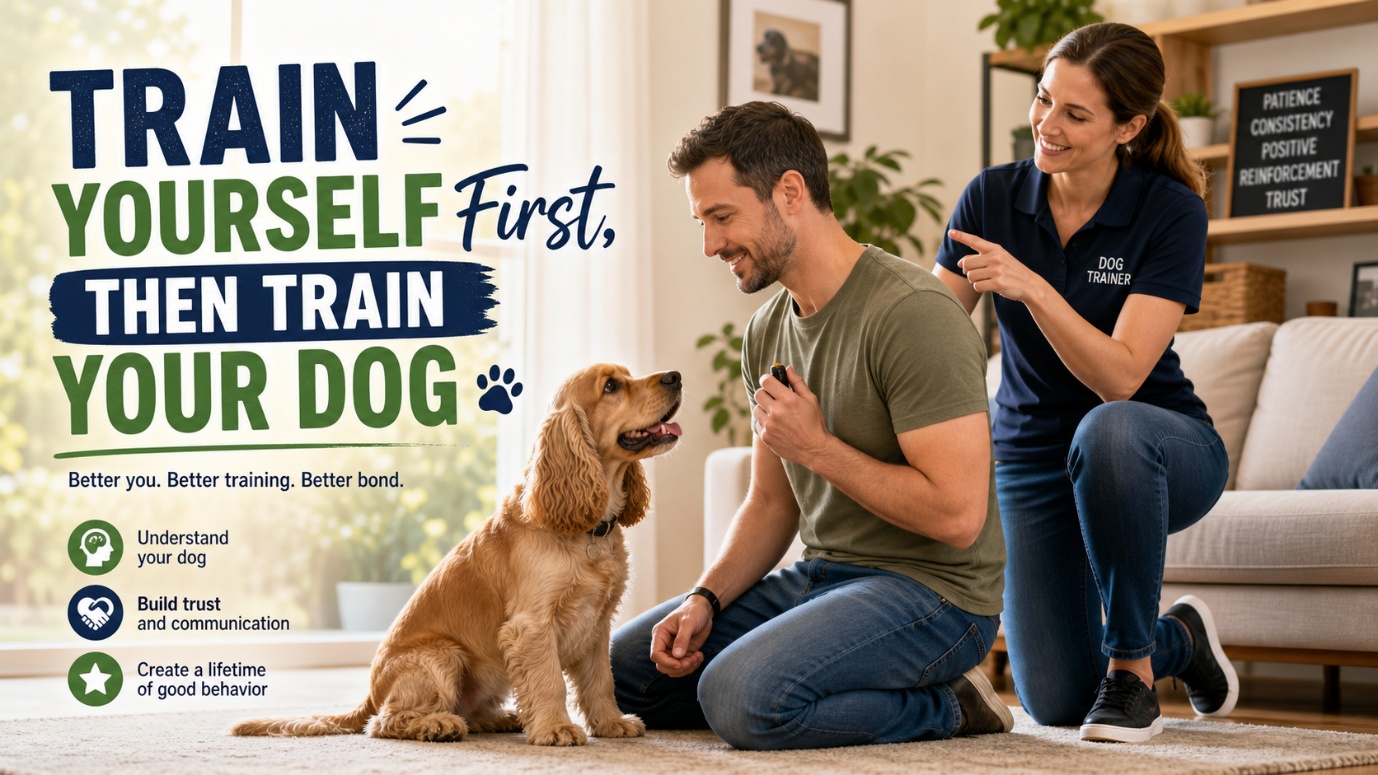
There is a common misconception in dog ownership that training is something you outsource. You find a professional, hand over your dog, and expect a well-behaved companion to be returned a few weeks later. It is an appealing idea, especially for busy owners or those struggling with challenging behaviour. But it misses something fundamental about the relationship between a dog and its owner.
A good dog trainer does not just train the dog.
• They train the owner.
At its core, dog training is not about commands. It is about communication. Dogs do not speak English, and they do not naturally understand what we expect of them. What they do understand is consistency, timing, tone, and body language. These are all things that cannot be handed off to someone else. They have to be learned and practised by the person the dog lives with every day.
If a dog only responds to the trainer, then the training has not really worked. It has simply been relocated.
This is why the most effective trainers focus on coaching the owner. They show you how to give clear signals, how to reinforce the right behaviours, and how to recognise what your dog is trying to tell you. In many ways, they act more like a teacher or a mentor than a service provider.
There is a useful comparison here with parenting. Imagine sending your child to school and expecting the teacher to handle all aspects of their learning and development, while you remain entirely uninvolved at home. It would not work. Children need consistency between school and home to truly learn and thrive. The same principle applies to dogs. Training is not a single environment activity. It is a daily, ongoing interaction shaped by the owner.
One of the biggest benefits of this approach is the strength of the bond it creates. When you actively participate in your dog’s training, you are not just correcting behaviour. You are building trust and understanding. Your dog learns to look to you for guidance, and you learn how to respond in a way that makes sense to them. This mutual understanding is what turns basic obedience into a genuinely cooperative relationship.
There is also a strong sense of personal satisfaction that comes with it. Seeing your dog respond to you, not because they were conditioned elsewhere, but because you have learned how to communicate effectively, is incredibly rewarding. It turns small successes into meaningful achievements. A calm walk, a reliable recall, or a settled response to distractions all become moments you have actively created together.
Beyond the emotional rewards, there is a practical advantage. Dogs do not exist in controlled environments. They live in real homes, with real distractions and unpredictable situations. If you have not developed the skills to guide your dog yourself, those situations can quickly become difficult. When you have been part of the training process, you are equipped to adapt, reinforce, and maintain good behaviour over time.
This is not to say professional trainers are not valuable. Quite the opposite. The right trainer is essential. But their role should be to empower you, not replace you. They provide the structure, the insight, and the techniques. You provide the consistency and the relationship.
In the end, training is not something that is done to your dog. It is something you do together. And that is where the real value lies. Not just in having a well-behaved dog, but in becoming a confident, capable owner who understands their companion on a much deeper level.